Technical data
| Size | 100 | 125 | 160 | 160T | 220 |
|---|---|---|---|---|---|
| Model | DC 100 ST | DC 125 ST | DC 160 ST | DC 160 ST Tandem | DC 220 ST Tandem |
| Max. load | 100 kg | 125 kg | 160 kg | 160 kg | 220 kg |
| Surface | 25.2 m² | 30.7 m² | 41.0 m² | 41.0 m² | 59.2 m² |
| Weight¹ | 1170 g | 1390 g | 1780 g | 1850 g | 2520 g |
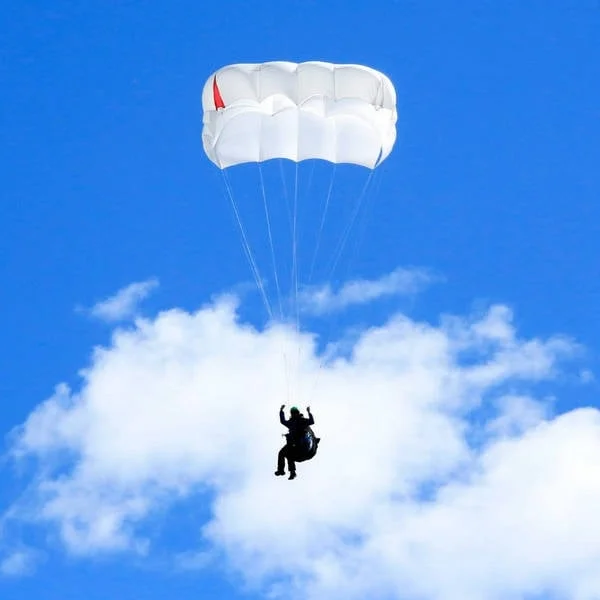
| DR² (max load) | 4.7 m/s /embed//F8cEEOoJJ3c” frameborder=”0″ allowfullscreen> DIAMONDcross ST presentation at Thermik 2017Tom Grabner explains the optionally steerable reserve system, showing action-videos. Charly DIAMONDcross ST packing instructionsDetailled video for packing a steerable Charly DIAMONDcross reserve system. DHV Interview with DIAMONDcross developerInterview with DIAMONDcross developer Tom Grabner. New tests performed for opening safety of the DIAMONDcrossAuthor and test pilot: Tom Grabner Already during the development of the DIAMONDcross, the topic “entanglement of the rescue system with the main glider” was crucial for diverse product details, which have been certified with additional tests far above certification criteria during the summer. The most dangerous situations for a rescue system becoming entangled with the main glider are SAT-like rotations after tangling up. This was simulated by holding collapses. In contrast to the urgent recommendation of DHV, to powerfully throw the parachute towards your legs to prevent the rescue becoming entangled with the main glider in such situations, the parachute has been deployed after the release out of the harness when tested, to simulate the “worst case”. The aim of the test was to prove that the DIAMONDcross reliably opens also in this situation. Particularly in such an exceptional state like rescue deployment in a stressful situation it might be possible that the pilot is not able to react correctly. The overall concept of the DIAMONDcross has integrated and considered these aspects of practice at the best. This makes the DIAMONDcross the rescue system with the highest opening safety! DIAMONDcross rescue system test videos: As shown in the videos of the tests, the construction features of the DIAMONDcross are absolutely decisive for a safe function of the rescue system in case of emergency, although they are not decisive for certification: 1) Conception of long liners The lines of the DIAMONDcross are longer, so that the opening of the rescue system does happen in the same radius of the main parachute and not in the area of the lines. The line length of the rescue system hardly has a negative impact on the opening time in the rotation, as the package immediately separates rapidly from the pilot. 2) Design of the inner container The inner container has a separate closure of the canopy, so that the lines are stretched before the canopy opens. This triggers a controlled release with a high separation of the parachute package. The parachute package which still has not opened rotates in the same direction as the main parachute while the lines are stretching. Only when the lines are stretched and with an appropriate safety distance to the main parachute, the canopy will release from the container. 3) Packing procedure By a special kind of packing, the DIAMONDcross opens instantly already on the base, before the peak has left the inner container. The higher the rotation speed, the faster the opening of the way of packing for the DIAMONDcross. This will be reached by a separate folding of both pre-sorted sides (instead of the usual long S-fold*), as well as a tube inner container, in which the parachute is packed in small S-folds. 4) Line geometry The different line lengths (due to its construction by controllability) fan out the panels. In this way several gaps occur for an instantaneous air circulation of the parachute base after leaving the inner container. EntanglementEntanglement of the rescue system with the main glider – this is a problem of conventional rescue systems, which is not detected in certification: Simultaneous releasing of lines and canopy If lines and canopy are set free at the same time, as for many integrated harness containers, the rescue system tends to open faster. This however effectuates in a rotation, when pulling it, the rescue system may open partially directly next to the pilot, thus the rescue system decelerates due to the increased air resistance and thereby is very likely blown in the lines of the main glider. Not without reason, the opening aids (the small parachutes on the container) which were quite famous meanwhile have disappeared from the market. Short lines A rescue system with short lines leads to a faster opening when throwing the rescue system during straight flight, but prevent in a rotation in case of emergency the sufficient separation of the rescue system and the main glider. Long S-fold When packing the rescue system, the long S-fold is still practised by habit. Especially in rotations, the rescue system can wrap around the line bundle, whereby the air circulation of the parachute’s base significantly slows down. Specifically for low activation altitude this can provoke that the rescue system does not catch the pilot before the crash. * A long S-fold is the longitudinal ,,S”-shaped folding of the canopy when packing the rescue system. FAQDo I have to disconnect my glider when opening the DIAMONDcross? No. Although if the pilot reacts in a passive way, the DIAMONDcross works perfectly. The risk of a side slip is very low for a DIAMONDcross. Nevertheless, the glider should be disconnected – if possible – from all reserve systems, no matter whether they are steerable or not. The disconnection can be made by separating the glider from the carabiner, as in this case, an automatic separation system for the speed system is absolutely essential. Further opportunities are rapid separation carabiners or cutting off the main lines by means of a jack knife. With the Finsterwalder Quick-Out carabiners, the disconnection is very simple. As you can’t make general statements about how the glider reacts after reserve deployment and every reserve system is always influenced by the residual resistance of the glider, a complete disconnection of the glider can only be an advantage – also if a disconnection is not absolutely necessary for the DIAMONDcross. Downloads
Related products
Sale!
JBL 6mm Male-to-Male Spearpoint AdapterOriginal price was: $2.64.$1.85Current price is: $1.85.
Sale!
Flying Cross Prime Flex Poly/Wool Men’s Class A Short Sleeve ShirtOriginal price was: $119.99.$78.65Current price is: $78.65.
Sale!
VANS CLASSIC SPORT STRIPE KNIT (VN0A7PMVBLK1)Original price was: $35.60.$21.47Current price is: $21.47.
Sale!
FUTURES LARGE FT1 HC THRUSTER (1008-128-00)Original price was: $80.00.$45.72Current price is: $45.72.
Sale!
Hoppes 7mm, .270-.284 Boresnake Den RifleOriginal price was: $19.99.$15.93Current price is: $15.93.
Sale!
Gnome & Fairy Fantasy Door – LeafOriginal price was: $27.96.$18.34Current price is: $18.34.
Sale!
Socksmith Bee My Honey SocksOriginal price was: $9.59.$5.70Current price is: $5.70.
Sale!
Allen Co, Inc. EZ Aim Splash Reactive Turkey Paper Targets – 8 packOriginal price was: $8.76.$4.91Current price is: $4.91. |